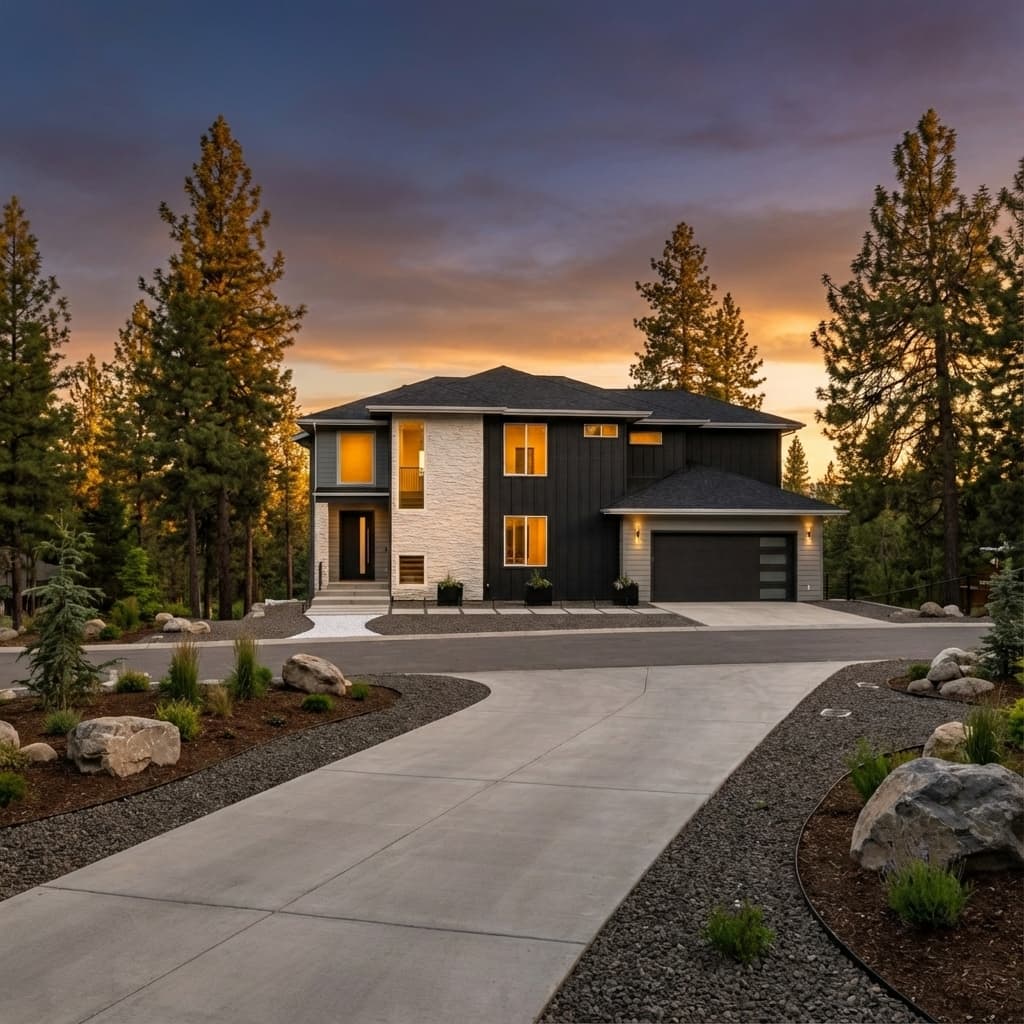
Spokane runs from −10°F in January to 100°F in July, and Washington has one of the strictest energy codes in the country. Here is what actually delivers comfort and low bills in this climate — and what is just expensive.
Spokane is a genuinely demanding climate to build in. We see below-zero mornings in January and stretches above 100°F in July, with wildfire smoke that increasingly makes "just open the windows" a bad answer in August.
Washington also has one of the most stringent residential energy codes in the United States. That is not a burden — it is why a well-built new home here is dramatically more comfortable and cheaper to run than the housing stock around it. But it does mean decisions have to be made deliberately.
Here is what matters in this climate, roughly in order of value per dollar.
The envelope comes first
You cannot mechanically compensate for a bad envelope. Every dollar spent on insulation, air sealing and glazing keeps paying; every dollar spent on oversized equipment to overcome a leaky shell pays once and then costs you forever.
Air sealing is the highest-return item on the list
Washington requires a blower-door test on new residential construction, with a maximum air leakage rate. Meeting the code minimum is table stakes. Beating it meaningfully is one of the cheapest performance upgrades available — a few thousand dollars in careful detailing at framing and rough-in stages.
The leaks that matter are not windows. They are:
- Top plate penetrations into the attic
- Rim joists
- Plumbing and electrical penetrations
- Can lights and bath fans
- The attic hatch
- Duct joints in unconditioned space
Sealing these is labour and attention during framing, not an expensive product. It is also nearly impossible to fix later.
Insulation
Under the current Washington State Energy Code in our climate zone, expect roughly:
- Attic: R-49 to R-60, with proper baffles so soffit ventilation is not blocked by insulation
- Walls: R-21 cavity insulation plus continuous exterior insulation, or a high-performance assembly meeting the equivalent U-factor
- Floors over unconditioned space: R-30+
- Slab edge and below-grade walls: insulated per code — commonly missed and a large comfort factor in a basement
Continuous exterior insulation is the detail worth understanding. Standard cavity insulation is bypassed by every stud — thermal bridging that can cut whole-wall performance by 15–25%. A layer of rigid foam or mineral wool outside the sheathing interrupts that path, dramatically improves comfort at the wall surface, and moves the condensation plane outward, which protects the framing.
Windows
Windows are the weakest part of any envelope. In our climate:
- U-factor at or below the code maximum, and lower is meaningfully better
- Low-E coatings tuned by orientation — this is free performance most builders ignore. Lower solar heat gain on west and south glass reduces summer overheating; higher gain on carefully shaded south glass helps in winter.
- Triple glazing is worth considering on north elevations and in bedrooms; it is a comfort upgrade as much as an energy one, because the interior glass surface stays warmer and there is no cold draft off the window.
- Installation quality matters as much as the window. A premium window sloppily flashed and foamed performs worse than a mid-range window installed properly.
Heating and cooling
Heat pumps work here
The most common objection we hear is that heat pumps do not work in cold climates. That was true twenty years ago. Cold-climate air-source heat pumps now maintain rated capacity well below 0°F, which covers the overwhelming majority of Spokane's heating hours.
The practical configuration for this climate:
- A cold-climate ducted heat pump sized to the actual calculated load (Manual J), not a rule of thumb
- Backup heat — electric resistance or gas — for the handful of extreme days
- Zoning on multi-storey homes, because heat stratification is real
Heat pumps also provide cooling, which used to be optional in Spokane and no longer is.
Ground-source (geothermal) heat pumps deliver excellent performance and very low operating costs, but the loop field is a large capital cost. On acreage with a horizontal loop and a long ownership horizon it can pencil. On a small lot requiring vertical bores, it usually does not.
Sizing beats equipment tier
An oversized system short-cycles: it never runs long enough to dehumidify or to distribute evenly, comfort suffers, and equipment wears out early. A properly sized mid-tier system consistently outperforms an oversized premium one. Insist on a load calculation.
Ventilation is not optional
A tightly sealed house needs mechanical fresh air. Washington code requires whole-house ventilation, and in Spokane the smart choice is a heat recovery ventilator (HRV) or energy recovery ventilator (ERV) — it exchanges stale indoor air for filtered outdoor air while recovering most of the heat.
In Spokane there is a second argument that has become decisive: wildfire smoke. An HRV or ERV with MERV 13 or better filtration means you can keep the house sealed and still breathe clean air through a smoke event in August. After the last several summers, this is one of the most appreciated features in the homes we build.
Water heating
Heat pump water heaters use roughly a third of the energy of standard electric resistance units. They need adequate air volume around them — a mechanical room or garage rather than a small closet — and they slightly cool the space they sit in, which is a bonus in summer and a minor cost in winter.
Also worth doing, and nearly free at rough-in: locate the water heater close to the primary bath group, insulate hot water lines, and keep runs short. Less waiting, less waste.
Solar
Spokane gets better solar production than people expect — our summers are sunny and long. The economics depend on system cost, utility rate structure, net metering rules, and available incentives at the time you build.
Even if you do not install now, make the house solar-ready: conduit from the attic to the electrical panel, adequate panel capacity and physical space, a structurally adequate south-facing roof plane, and a roof design that leaves an uninterrupted array area free of vents and dormers. This costs very little during construction and saves thousands later.
What we would prioritise on a fixed budget
If you have $30,000 of discretionary performance budget on a Spokane home:
- Aggressive air sealing beyond code minimum — a few thousand dollars, the largest comfort and efficiency return available
- Continuous exterior insulation — eliminates thermal bridging, protects the assembly
- HRV/ERV with high-grade filtration — health, comfort, and smoke resilience
- Correctly sized cold-climate heat pump with a real load calculation
- Better windows on the elevations that need them, tuned by orientation
- Heat pump water heater
- Solar-ready infrastructure
Notice that the first three are largely detailing and labour, not glamorous equipment. That is generally how high-performance building works.
The comfort argument beats the payback argument
People ask about payback periods. It is a reasonable question and the answers are usually decent — but it undersells the result.
A well-built envelope means no cold rooms above the garage, no draft off the window seat, no 5°F difference between upstairs and downstairs, quiet interiors, and clean air in smoke season. Those are things you experience every single day for thirty years. The utility bill is almost a side effect.
Build it right the first time
Nearly everything above is buried in walls, attics, and crawlspaces. Retrofitting it later costs several times what it costs to build in — and some of it cannot be retrofitted at all.
We build to Washington's energy code as a floor, not a target. If you want to talk about what high performance looks like on your project and your budget, get in touch or read about our build process.