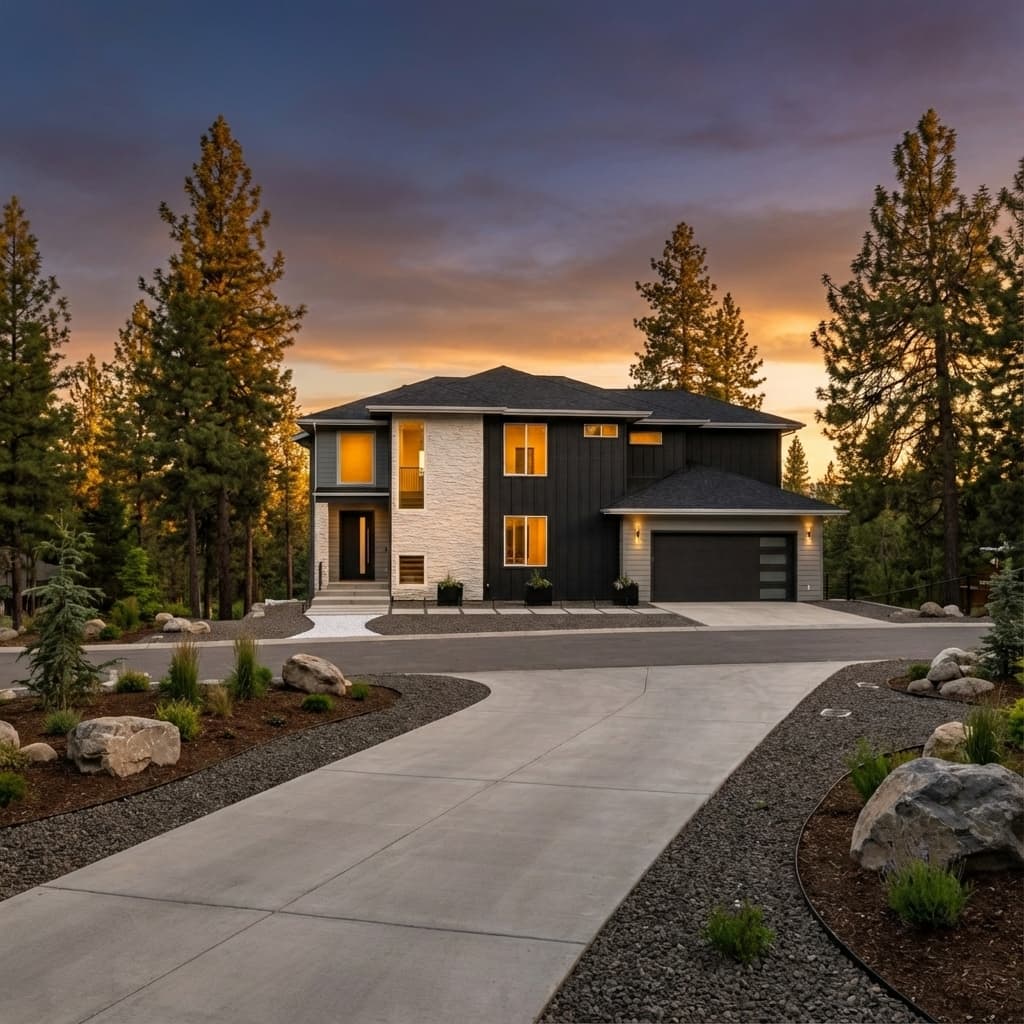
Most Spokane fire rebuilds take 14 to 24 months from the fire to move-in. Here is what happens in each phase, which steps run in parallel, and the three decisions that actually shorten the schedule.
Nobody asks this question casually. If you are asking, you are living somewhere temporary, your Additional Living Expense coverage has a clock on it, and you want to know when this ends.
The honest answer for Spokane County: 14 to 24 months from the fire to move-in, with mass-loss events pushing toward the upper end and beyond. Here is where that time actually goes, phase by phase — including the parts that surprise people.
Phase 1 — Claim and stabilization (weeks 1–8)
Opening the claim, meeting the adjuster, documenting the loss, completing the contents inventory, and securing temporary housing.
Nothing physical happens on the lot during this phase, and that is normal. What matters is that the paperwork is moving. The families who lose the most time here are the ones who wait for the insurance company to tell them what to do next.
Do in parallel: start interviewing builders and designers now. It costs nothing and it saves months.
Phase 2 — Debris removal and site clearing (weeks 4–16)
Hazardous material screening, structural debris removal, ash and contaminated soil removal, foundation evaluation, and utility disconnection.
After a large fire this is usually sequenced by the county or a state-managed program across the entire burn area — meaning your position in the queue is not entirely under your control. Private removal is sometimes faster but comes out of your claim.
Do in parallel: design. Truly. There is no reason to wait for a clear lot to decide on a floor plan.
Phase 3 — Design and engineering (weeks 6–20)
Floor plans, elevations, structural engineering, energy code compliance calculations, and a site plan. If you are rebuilding the same footprint from existing plans, this can be short. If you are redesigning — which many families do — plan on 8 to 16 weeks.
This is the phase where you actually decide what you are rebuilding. It is worth doing properly. It is also, critically, the phase most people start too late.
Phase 4 — Permitting (weeks 16–32)
Submittal to Spokane County or the City of Spokane, plan review, corrections, resubmittal, and issuance. Normal review is typically 4 to 10 weeks. After a mass-loss event, review queues can double, though jurisdictions often add staff and create expedited rebuild tracks.
Septic, well, driveway approach, and — in the wildland-urban interface — fire-hardening reviews may run as separate approvals with their own timelines.
See Spokane County building permits after a fire for the specifics.
Phase 5 — Site work and foundation (weeks 30–40)
Excavation, footings, foundation walls, waterproofing, backfill, underground utilities, and the slab. Roughly 4 to 8 weeks of actual work, but weather-dependent. In Spokane, concrete work between late November and February gets expensive and slow — cold-weather protection is real money.
Phase 6 — Framing and dry-in (weeks 38–52)
Floor system, walls, roof trusses, sheathing, roofing, windows, and exterior doors. 6 to 12 weeks.
This is the phase that feels like progress, because it is visible. It is also where truss and window lead times bite. Order those early.
Phase 7 — Mechanical rough-in and insulation (weeks 50–60)
Plumbing, electrical, and HVAC rough-in, then rough inspections, then insulation and air sealing, then the blower-door test required under the Washington State Energy Code, then drywall. 6 to 10 weeks, and heavily dependent on inspection scheduling.
Phase 8 — Interior finishes (weeks 58–80)
Drywall finish, paint, trim and doors, cabinetry, countertops, flooring, tile, plumbing and electrical trim, and appliances. 10 to 16 weeks.
Cabinetry and countertop lead times are the usual bottleneck. Selections made late are the single most common cause of finish-phase delays, and they are entirely within your control.
Phase 9 — Exterior completion, final inspections, occupancy (weeks 76–88)
Siding, decks, driveway, grading, landscaping, punch list, final inspections, and the certificate of occupancy. 4 to 8 weeks.
What actually shortens the schedule
Three things, in order of impact:
1. Start design during debris removal
The single biggest lever. Design and permitting take four to seven months and require nothing to be happening on the lot. Families who begin design in month two are pouring foundations while their neighbours are still choosing an architect.
2. Make selections early and commit
Cabinets, windows, appliances, tile, plumbing fixtures. Every one of these has a lead time, and lead times run concurrently with construction only if the order is already placed. A homeowner who finalizes selections before framing starts saves four to eight weeks.
3. Rebuild on the existing footprint
Same footprint, same setbacks, same septic siting, same driveway. This is the fastest permit path there is. Expanding the footprint or relocating the structure is often worth it — just budget the extra review time honestly.
What makes it longer
- Waiting to hire a builder until the lot is clear
- Redesigning during construction (change orders reset schedules, not just budgets)
- Underinsurance discovered late, forcing a re-scope in month eight
- Winter framing and foundation work in Eastern Washington
- Contested insurance items that hold up funding draws
- Choosing an out-of-area contractor unfamiliar with local inspection sequencing
Managing the ALE clock
If your Additional Living Expense coverage caps at 12 months and the realistic rebuild runs 20, you have a gap. Address it early:
- Confirm the exact dollar limit and the time limit in writing
- After a declared disaster, ask about extensions — many carriers grant them, and some states mandate them
- Document every delay outside your control; it supports an extension request
- Budget for the gap rather than discovering it
The bottom line
A fire rebuild is a long project even when everything goes right. What you control is the front end: how fast you get into design, how decisively you make selections, and whether you hire a builder who knows how Spokane County sequences inspections.
If you want a realistic, property-specific schedule for your lot, talk to us. We will give you a straight answer, including the parts you will not like.