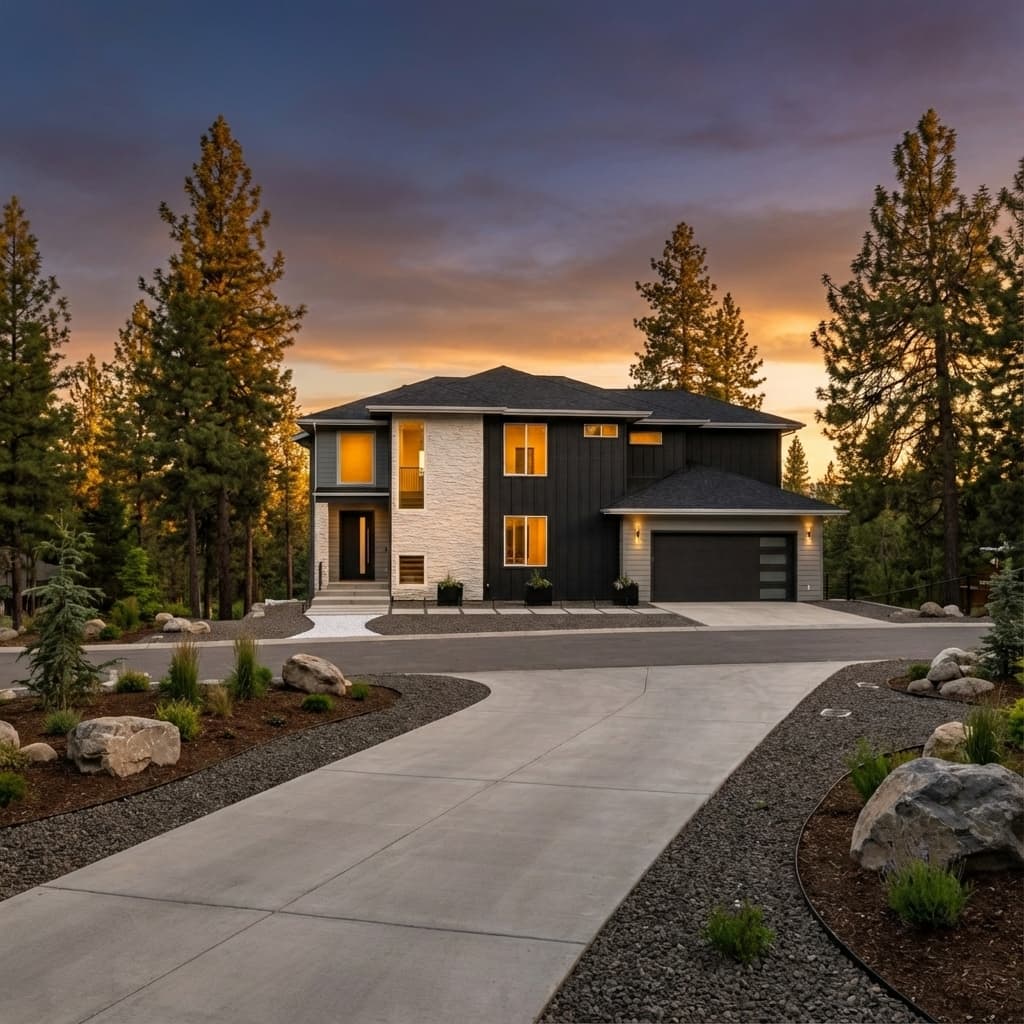
There are hundreds of builders in the Spokane area and the good ones do not always market the loudest. These are the twelve questions that separate a builder who will finish your home well from one who will not.
Search "custom home builders Spokane" and you will get hundreds of results. Directory listings, national franchises with a local branch, two-person outfits, and family companies that have been here for decades. Almost none of them look meaningfully different from the outside.
The stakes are high. A custom home is the largest single purchase most families ever make, and unlike a house you buy, you are paying for something that does not exist yet, based on a promise.
After nearly sixty years of building in Spokane County, here is what we would ask if we were on your side of the table.
1. Are you registered, bonded and insured in Washington — and can I verify it right now?
Every contractor in Washington must be registered with the Department of Labor & Industries. Registration requires a bond and liability insurance. L&I publishes a free "Verify a Contractor" lookup that shows registration status, bond amount, insurance, expiration dates, and any complaint or lawsuit history.
Do not take a business card's word for it. Look it up yourself, on the spot. A builder who is not comfortable with you doing that has answered a different question.
Ask separately about workers' compensation coverage and whether their subcontractors carry their own. If they do not, you can end up exposed for an injury on your property.
2. How many homes have you built in Spokane County specifically?
Local matters more in construction than in almost any other trade. A builder working in Spokane County needs to know:
- Frost depth and cold-weather concrete practice for Eastern Washington winters
- Our soils — basalt, glacial till, and the areas where you will hit rock at four feet
- Spokane County and City of Spokane permitting, and the Spokane Regional Health District septic process
- Which subcontractors actually show up
- Washington State Energy Code compliance, which is stricter than most of the country
A builder relocating from a warmer, faster-permitting market will learn all of this on your project.
3. Can I see a home you finished five years ago — not just last month?
Anyone can photograph a house on handover day. What you want to know is how it looks after five Spokane winters of freeze-thaw.
Ask for addresses of older projects. Better, ask to speak to the family living in one. The question to ask them is not "were you happy" — it is "what happened when something went wrong?" Every project has problems. What distinguishes builders is the response.
4. What is your contract type, and what exactly is fixed?
The three common structures:
- Fixed price: one number for a defined scope. Predictable, but every change is a change order, and a bid that is too good usually means an incomplete scope.
- Cost-plus: actual costs plus a fee, either a percentage or fixed. Transparent, but the final number is genuinely unknown at signing.
- Guaranteed maximum price: cost-plus with a ceiling. Often the fairest structure for a true custom home, if the builder is honest about the estimate underneath it.
There is no universally right answer. There is a wrong answer, which is not knowing which one you signed.
5. Show me a real allowance schedule
Allowances are placeholder budgets for items you have not selected yet — cabinets, counters, flooring, plumbing fixtures, lighting, appliances, tile.
This is where low bids hide. A builder can win the job with a $28,000 cabinet allowance for a home that genuinely needs $55,000 of cabinetry, and the difference becomes a change order in month ten.
Ask for the allowance schedule line by line, and ask this question: "If I picked mid-range products from a local supplier today, would these allowances cover it?" Watch how they answer.
6. What is your change order process?
Custom homes change. That is normal. What matters is that changes are:
- Priced in writing before work proceeds
- Approved by you in writing
- Reflected in an updated contract sum and, when relevant, an updated schedule
"We will settle up at the end" is how relationships end.
7. How many projects will you be running while you build mine?
There is no magic number, but there is a real answer. A builder running four homes with a dedicated superintendent per site is different from one running twelve out of a truck.
Ask specifically: who is on my site daily, and what is their name? Then ask how many other projects that person is responsible for.
8. How do you communicate, and how often?
You should expect at minimum:
- A named single point of contact
- Scheduled updates on a defined cadence — weekly is standard
- Access to the project schedule and current budget status
- A response time commitment for questions
Many builders now run a client portal with photos, schedules, selections, and financials. It is not mandatory, but a builder who resists any form of documented reporting is telling you something.
9. Who are your subcontractors, and how long have you worked with them?
The framers, plumbers, electricians, HVAC installers, and finish carpenters build your house. The builder coordinates them.
A builder with a stable trade base going back a decade gets better crews, better pricing, and better response on warranty calls. A builder who bids every trade out fresh on every job gets whoever was cheapest that month.
10. What does your warranty actually cover, and for how long?
Washington law provides certain implied warranties, but you want the written one. Typical structure:
- 1 year on workmanship and materials
- 2 years on mechanical, electrical and plumbing systems
- 10 years on major structural components
Then ask the real question: who handles warranty calls in year two, and how fast? Ask a past client that same question.
11. Can you show me a realistic schedule with actual milestones?
Not "about a year." A phase-by-phase schedule: design, permitting, site work, foundation, framing, dry-in, rough-ins, insulation, drywall, finishes, final inspections.
A builder who cannot produce this has not planned your project. A builder who promises a custom home in six months in Spokane has not built one here.
12. What happens if you go out of business mid-project?
Uncomfortable, and worth asking. It happens, especially to builders who grew fast on thin margins.
Related and easier to verify: how are draws structured, and are lien releases collected from every sub at every draw? A homeowner who pays a builder in full while subcontractors go unpaid can face liens on their own home. Lien releases at each draw are basic protection, and any competent builder does this as a matter of course.
Red flags worth walking away from
- A bid materially below every other bid — the scope is incomplete, and you will pay the difference later
- Pressure to sign quickly, or a "price only good this week"
- A large upfront deposit before permits or materials
- No written contract, or a contract without a defined scope and schedule
- Reluctance to provide references or L&I verification
- Vague, verbal-only answers about allowances
What we would want you to notice
The builders worth hiring in Spokane tend to answer these questions immediately, in detail, without getting defensive — because they have answered them before and the answers are good.
We have been building here since 1967, and we built our whole process around this: an open-door policy, a real line-item budget, and clients who can walk their own job site any day of the week and ask any question they want.
If you are interviewing builders, come talk to us — even if it is just to have a benchmark for the other conversations. You can also see how our custom build process works and what we have built.